


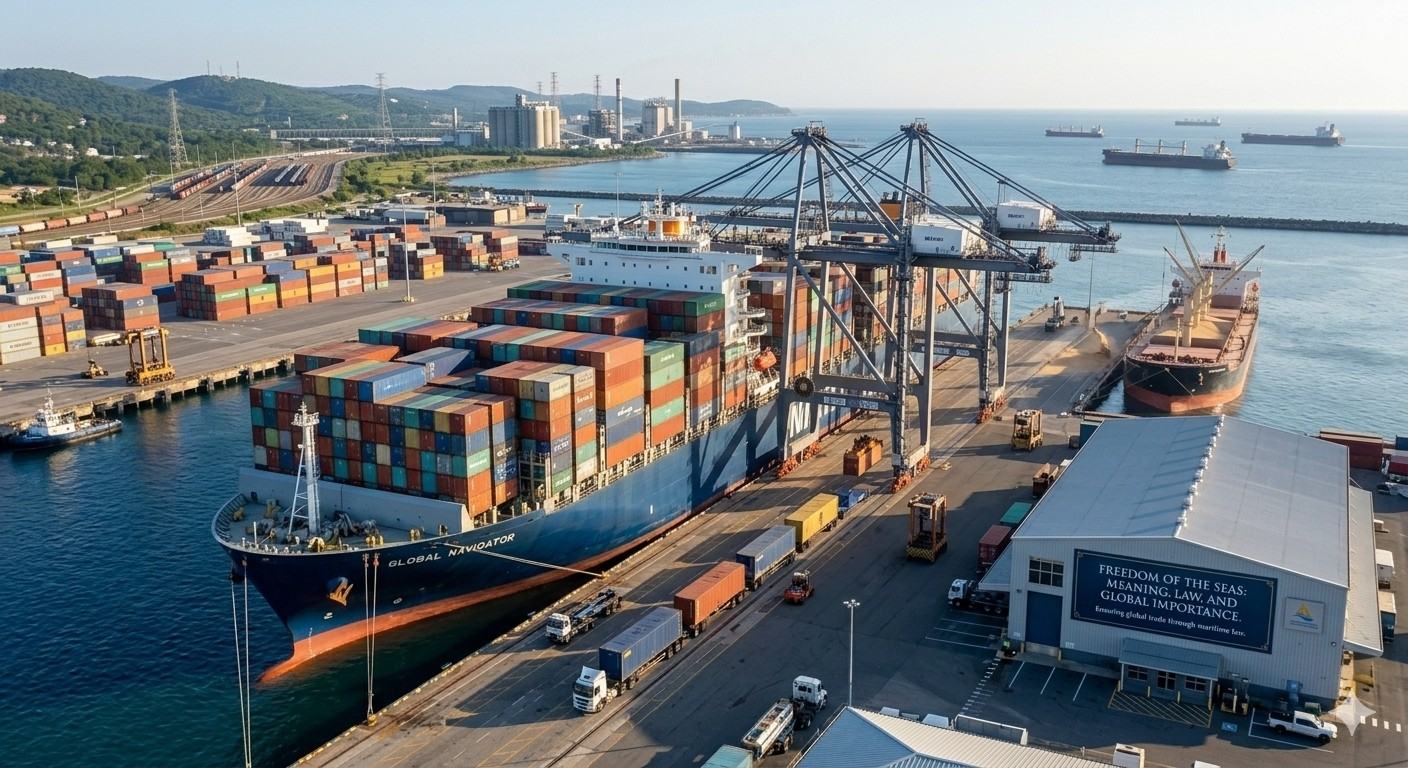
The concept of freedom of the seas is one of the most important principles in international law and global trade. It shapes how ships move across oceans, how nations interact on maritime routes, and how global commerce functions without unnecessary restrictions. In simple terms, freedom of the seas ensures that no single country can claim ownership over the open ocean, allowing peaceful navigation and economic activity for all nations.
In today’s interconnected world, freedom of the seas plays a critical role in maintaining stable shipping routes, supporting international trade, and reducing geopolitical tensions. Without it, global supply chains would face serious disruption, and access to essential goods would become highly uncertain.
This article explores the history, legal framework, economic importance, and modern challenges of freedom of the seas, while also answering key questions users commonly search for.
What is Freedom of the Seas?
The principle of freedom of the seas refers to the idea that the oceans beyond national jurisdictions are open to all countries. No state can claim sovereignty over international waters, and all nations have equal rights to navigation, trade, and communication.
At its core, freedom of the seas supports equal access to maritime spaces, ensuring that ships from any country can travel across oceans without interference, provided they follow international law.
Key aspects include:
- Free navigation on international waters
- Equal access to shipping lanes
- Protection of undersea communication cables
- Non-interference by coastal states in high seas zones
- Legal balance between sovereignty and global access
Modern interpretations of freedom of the seas are shaped by international agreements like the United Nations Convention on the Law of the Sea (UNCLOS), which defines maritime boundaries and responsibilities.
Historical Origins of Freedom of the Seas
The idea of freedom of the seas dates back to the early 17th century, when legal scholars debated whether oceans could be owned. Dutch jurist Hugo Grotius famously argued for open seas in his work Mare Liberum.
At that time, European powers were competing for control of trade routes, and restricting access to oceans was seen as a way to dominate global commerce. Grotius challenged this idea, laying the foundation for modern freedom of the seas principles.
Over time, nations gradually accepted that open oceans benefit everyone. The expansion of global trade in the 19th and 20th centuries strengthened freedom of the seas as a widely accepted international norm.
Today, this principle is embedded in global maritime law and remains essential for peaceful international relations.
UNCLOS and Modern Maritime Law
The United Nations Convention on the Law of the Sea (UNCLOS) is the most important legal framework governing freedom of the seas today.
UNCLOS defines:
- Territorial waters (up to 12 nautical miles)
- Exclusive Economic Zones (EEZs up to 200 nautical miles)
- High seas (beyond national jurisdiction)
- Rights and responsibilities of coastal and flag states
Within this system, freedom of the seas applies primarily to the high seas, where all countries share equal rights.
Key Legal Principles
Under UNCLOS, freedom of the seas includes:
- Freedom of navigation
- Freedom of overflight
- Freedom to lay submarine cables
- Freedom of fishing (with regulations)
- Freedom of scientific research
These rules ensure that freedom of the seas remains balanced with environmental protection and national security concerns.
However, disputes still arise when countries interpret maritime boundaries differently, making freedom of the seas a continuously evolving legal concept.
Importance of Global Trade and Shipping Routes
The global economy depends heavily on freedom of the seas. More than 80% of international trade by volume is transported by sea, making open and secure oceans essential for economic stability.
Major shipping routes like the Suez Canal, Strait of Malacca, and Panama Canal rely on the principles of freedom of the seas to function efficiently.
Why it matters for trade:
- Ensures uninterrupted global supply chains
- Reduces transportation costs
- Enables international energy distribution
- Supports global import/export systems
- Promotes economic interdependence
Without freedom of the seas, global trade would slow dramatically, increasing costs for goods and disrupting markets worldwide.
In essence, freedom of the seas is not just a legal principle; it is the backbone of modern globalization.
Freedom of Navigation and Geopolitical Tensions
In modern geopolitics, freedom of the seas is often tested through Freedom of Navigation Operations (FONOPs). These are missions conducted by naval forces to challenge excessive maritime claims by other states.
Tensions arise when countries attempt to expand control over disputed waters, leading to diplomatic conflicts.
Key issues include:
- Territorial disputes in the South China Sea
- Military presence in strategic waterways
- Competing EEZ claims
- Naval patrol operations
- Strategic chokepoints
Despite these challenges, freedom of the seas remains a cornerstone of international stability. It helps prevent any single nation from dominating global maritime trade routes.
Maintaining freedom of the seas is therefore a shared responsibility among maritime powers.
Challenges Facing Freedom of the Seas
Although widely accepted, freedom of the seas faces several modern challenges that threaten its effectiveness.
1. Piracy and Maritime Crime
Piracy in regions like the Horn of Africa disrupts safe navigation and undermines freedom of the seas.
2. Environmental Regulations
Stricter environmental laws aim to protect oceans but can sometimes complicate maritime access and operations under freedom of the seas.
3. Territorial Disputes
Competing claims over islands and reefs can limit the practical application of freedom of the seas in contested regions.
4. Military Expansion
Increased naval presence by major powers sometimes raises concerns about restricting freedom of the seas indirectly.
Despite these issues, international cooperation continues to reinforce freedom of the seas as a guiding principle.
Future of Freedom of the Seas (2025 and Beyond)
The future of freedom of the seas will be shaped by technological advancement, climate change, and evolving geopolitical dynamics.
Emerging trends include:
- Expansion of Arctic shipping routes due to melting ice
- Increased digital tracking of maritime traffic
- Greater environmental enforcement at sea
- Autonomous shipping technologies
- Rising importance of cybersecurity in maritime systems
As global trade expands, freedom of the seas will remain essential for ensuring fairness and accessibility in ocean governance.
However, balancing national security, environmental protection, and open access will be the key challenge moving forward.
Frequently Asked Questions (FAQs)
What does freedom of the seas mean in simple terms?
It means all countries can use international waters for navigation and trade without claiming ownership over them, reflecting the principle of freedom of the seas.
Who created the concept of freedom of the seas?
The idea was developed by Hugo Grotius in the 17th century and later evolved into modern international law supporting freedom of the seas.
Is freedom of the seas still relevant today?
Yes, freedom of the seas is crucial for global trade, military navigation, and international cooperation.
Does any country control international waters?
No single country controls the high seas, which are governed by international agreements under the freedom of the seas principles.
Conclusion
The principle of freedom of the seas remains one of the most important foundations of global stability, trade, and cooperation. It ensures that oceans remain open, shared, and governed by international law rather than individual control.
From historical debates to modern UNCLOS regulations, freedom of the seas has evolved into a critical system that supports the global economy and prevents maritime conflicts.
As the world moves toward 2025 and beyond, protecting freedom of the seas will be essential for maintaining peace, enabling commerce, and ensuring equal access to the world’s oceans.
